What Do Those Numbers on Your Tire Actually Mean?

Andrew Whited • June 16, 2026

What Do Those Numbers on Your Tire Actually Mean?
Posted by Woodard's Smooth Ride LLC | Portland, TN

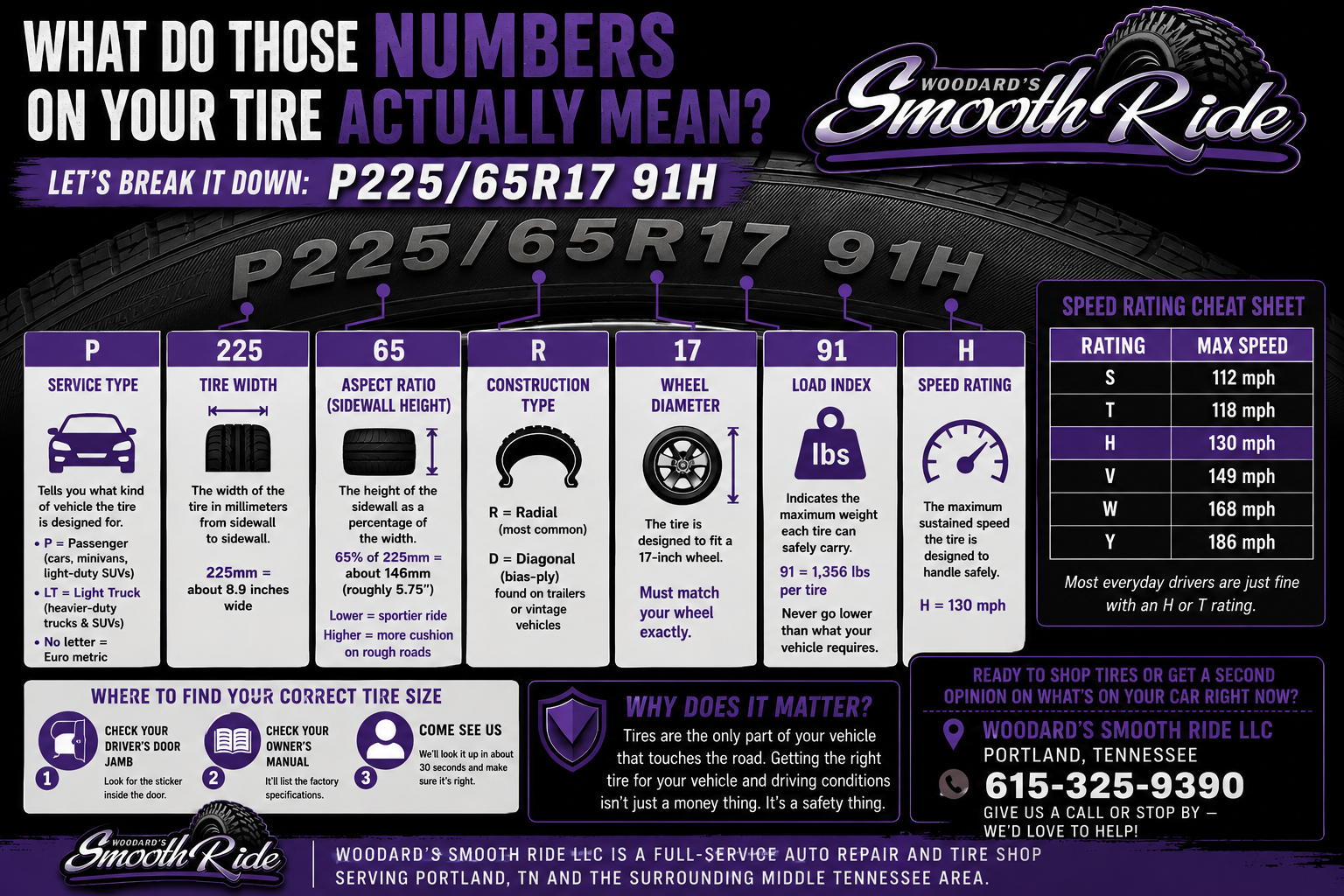
You've seen them a thousand times. That string of letters and numbers stamped on the side of your tire — something like 225/65R17 91H — staring back at you like a secret code. Most people just ignore it. But those numbers tell you everything about your tire, and knowing how to read them could save you from buying the wrong ones or, worse, driving on tires that aren't right for your vehicle.

Don't worry. We're going to break it down in plain English. No engineering degree required.

Let's Use a Real Example

Take this tire size: P225/65R17 91H

Each piece of that code means something specific. Let's go left to right.

"P" — What Kind of Tire Is It?

The letter before the numbers tells you the tire's service type.

  • P = Passenger vehicle (cars, minivans, light-duty SUVs)
  • LT = Light Truck (heavier-duty trucks and SUVs, especially ones that tow or haul)
  • No letter = Euro metric tire (similar to P-type, just sized slightly differently)

If your truck is rated for towing and you slap P-rated tires on it, you could be in trouble. LT tires are built to handle the extra load. This is one of those things that really matters.

"225" — How Wide Is the Tire?

This number is the width of the tire in millimeters, measured from sidewall to sidewall.

So 225 means the tire is 225mm wide — roughly 8.9 inches across.

The bigger this number, the wider the tire. Wider tires can give you better grip and a sportier look, but they're not always the right move. Always stick with the width your vehicle was designed for unless you know what you're doing (or ask us — we love this stuff).

"65" — The Aspect Ratio (a.k.a. the Sidewall Height)

This is the one that confuses people the most. The 65 is the aspect ratio — it's a percentage that tells you how tall the sidewall is relative to the tire's width.

So in our example:

  • Width = 225mm
  • Sidewall height = 65% of 225mm = about 146mm (roughly 5.75 inches)

Lower aspect ratio = shorter sidewall = sportier ride Higher aspect ratio = taller sidewall = more cushion on rough roads

This is why those low-profile tires on sports cars look so slick but feel like you're driving over every pebble on the road. And it's why your grandpa's old Buick rode like a cloud — tall sidewalls absorb a lot of road imperfections.

Here in Middle Tennessee, where we've got our fair share of rough roads and potholes, this number matters more than people think.

"R" — The Construction Type

The R stands for Radial, which just means the internal cords of the tire run perpendicular to the direction of travel. Nearly every tire made today is a radial. If you ever see a "D" here, that stands for Diagonal (bias-ply), which you'd typically only find on trailers or vintage vehicles.

Short version: if it says R, you're good. That's normal.

"17" — The Wheel Diameter

This one's simple. 17 means the tire is designed to fit a 17-inch wheel. That's the diameter of the rim it mounts on.

This number has to match your wheel exactly. A 17-inch tire on a 16-inch rim? Not happening. Always match this to your wheels.

"91" — The Load Index

Now we're getting into the lesser-known stuff. The 91 is the load index — a number that corresponds to the maximum weight the tire can safely carry.

A load index of 91 means each tire can handle up to 1,356 lbs. On four tires, that's over 5,400 lbs of capacity — plenty for most passenger vehicles.

You can find load index charts online, but the takeaway is simple: don't go lower than what your vehicle requires. Going higher is usually fine. Going lower is a safety issue.

"H" — The Speed Rating

Last up: the speed rating. The H tells you the maximum sustained speed the tire is designed to handle safely.


Most everyday drivers are just fine with an H or T rating. But if you've got a performance vehicle, you'll want to match or exceed the original rating. Putting an S-rated tire on a car designed for V-rated tires means the tire isn't built for the heat and stress your car can generate at higher speeds.

Where to Find Your Correct Tire Size

Not sure what size you need? You've got a few options:

  1. Check your driver's door jamb — there's usually a sticker right inside the door with your recommended tire size, load rating, and inflation pressure.
  2. Check your owner's manual — it'll list the factory spec.
  3. Come see us — we'll look it up in about 30 seconds and make sure you're getting exactly what your vehicle needs.

Why Does Any of This Matter?

Because tires are the only part of your vehicle actually touching the road. Brakes, steering, handling, fuel economy — it all runs through four patches of rubber about the size of your hand. Getting the right tire for your vehicle and driving conditions isn't just a money thing. It's a safety thing.

At Woodard's Smooth Ride in Portland, TN, we carry a wide selection of tires and we'll help you decode all of this so you leave confident — not confused. Whether you're replacing one tire or all four, we'll make sure you get the right fit at a fair price.

Ready to shop tires or get a second opinion on what's on your car right now?

📍 Woodard's Smooth Ride LLC — Portland, Tennessee 📞 Give us a call or stop by — we'd love to help.


Woodard's Smooth Ride LLC is a full-service auto repair and tire shop serving Portland, TN and the surrounding Middle Tennessee area.
By Woodard's Smooth Ride June 14, 2026
Discover top suspension insights from Woodard's Smooth Ride in Portland, TN. Enhance your vehicle's performance with expert guidance. Visit us today!
By Woodard's Smooth Ride May 17, 2026
Discover expert tire insights at Woodard's Smooth Ride in Portland, TN. Offering top-notch tire services for a smooth drive. Schedule an online appointment now!
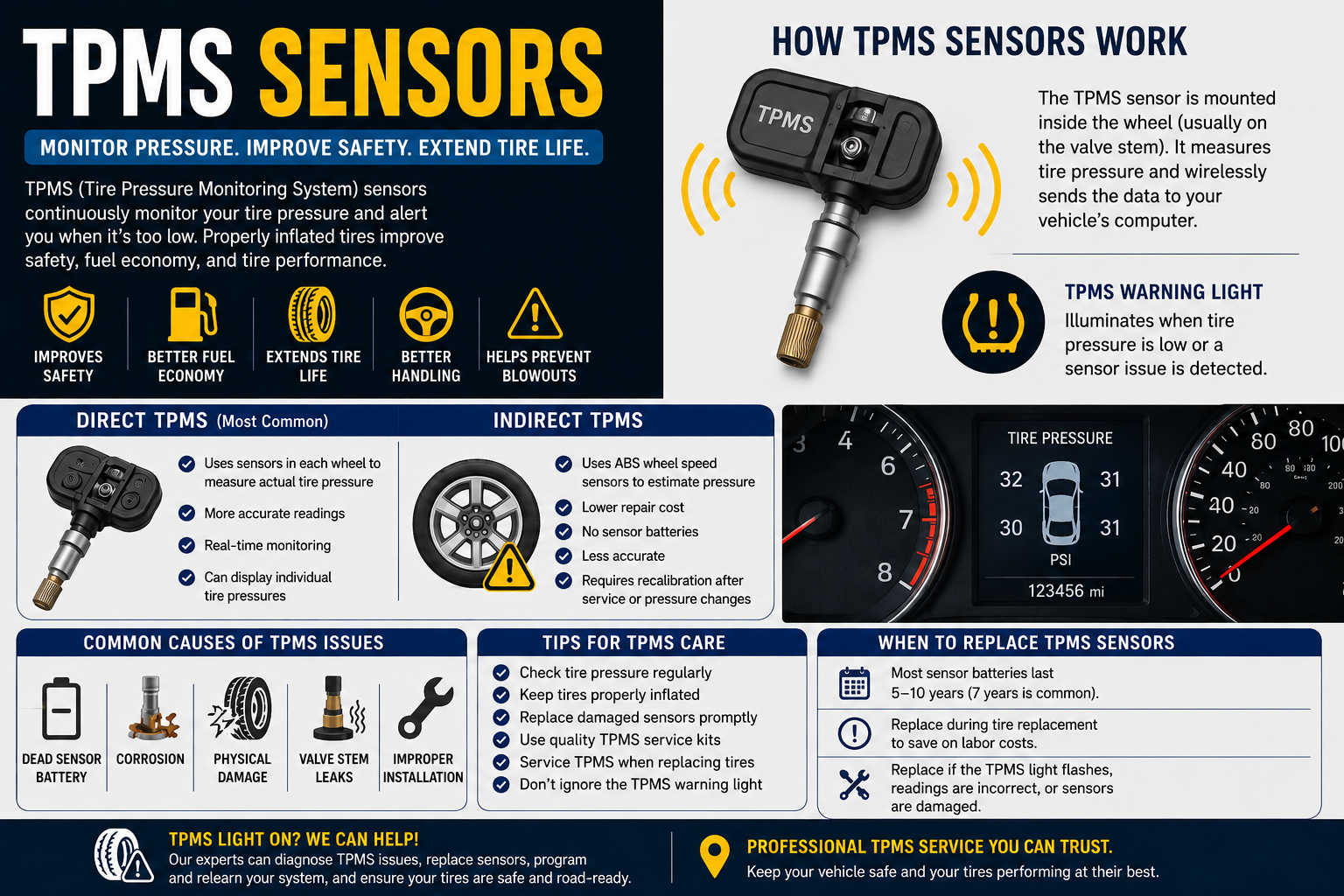
TPMS sensor infographic showing tire pressure monitoring and warning light info
By Andrew Whited May 6, 2026
Learn how TPMS sensors work, why tire pressure matters, common TPMS problems, and when to replace failing tire pressure sensors.
By Woodard's Smooth Ride April 19, 2026
Explore expert auto maintenance tips with Woodard's Smooth Ride in Portland, TN. Enhance your car's performance. Call us today!
By Woodard's Smooth Ride March 22, 2026
Discover expert alignment services in Portland, TN at Woodard's Smooth Ride. Ensure optimal vehicle performance and safety. Visit us today!
By Andrew Whited March 18, 2026
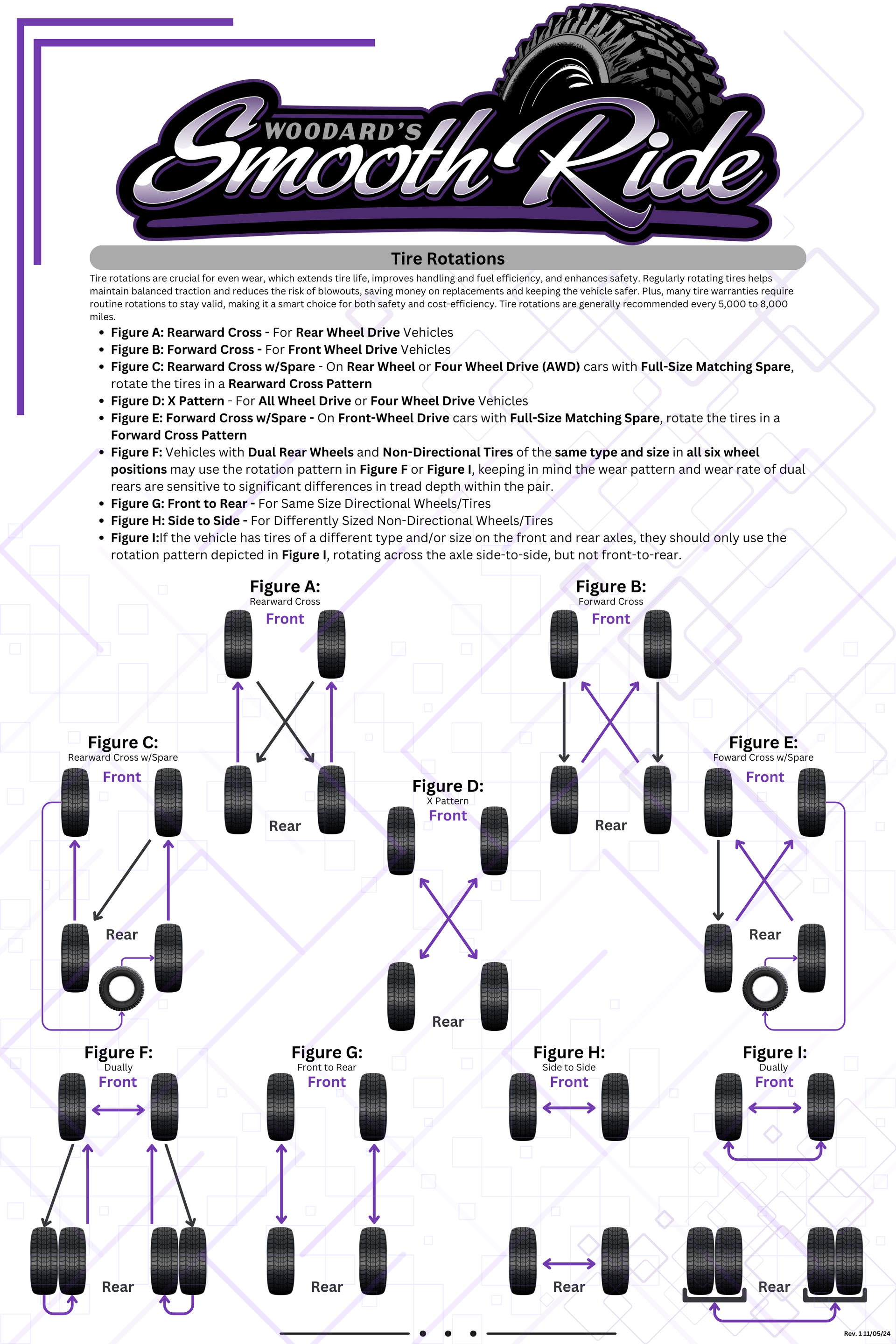
# Why Tire Rotations Matter (And How They Save You Money) When it comes to getting the most out of your tires, **regular tire rotations are one of the simplest—and most overlooked—maintenance services**. Most drivers don’t think about rotations until there’s a problem. By then, uneven wear has already shortened the life of the tires. Let’s break down what a tire rotation actually does—and why it matters. What Is a Tire Rotation? A tire rotation is the process of moving each tire to a different position on the vehicle . This is done to: Promote even tread wear Extend tire life Maintain proper handling and traction Different vehicles use different rotation patterns depending on: Front-wheel drive Rear-wheel drive All-wheel drive Tire type (directional vs non-directional) Why Tire Rotations Are So Important 1. Prevent Uneven Wear Your front tires do most of the work—steering, braking, and carrying engine weight. Because of that, they wear faster than the rear tires. Without rotation: Front tires wear out early Rear tires still have usable tread You end up replacing tires sooner than necessary 2. Extend Tire Life Routine rotations can add thousands of miles to your tires . That means: Fewer tire purchases Better return on your investment More consistent performance over time 3. Improve Safety Uneven tread = reduced traction. That can lead to: Poor braking performance Reduced wet-road grip Increased risk of hydroplaning Even wear keeps your vehicle stable and predictable. 4. Protect Your Suspension & Alignment Irregular wear patterns can indicate: Alignment issues Worn suspension components Regular rotations help catch these problems early—before they turn into expensive repairs. How Often Should You Rotate Your Tires? A good rule of thumb: 👉 Every 5,000–6,000 miles 👉 Or every oil change However, this can vary depending on: Driving habits Vehicle type Tire type If you’re unsure, your shop should track and recommend intervals for you. Signs You’re Overdue for a Rotation Watch for these indicators: Uneven tread wear (inside or outside edges) Vibration while driving Road noise increasing Vehicle pulling slightly to one side If you notice any of these, it’s time to get your tires checked. What Happens If You Skip Rotations? Skipping rotations can cost you—literally. You may experience: Premature tire replacement Reduced fuel efficiency Poor ride quality Voided tire warranties (many require documented rotations) Why Choose a Professional Rotation? At a professional shop, a tire rotation isn’t just moving tires around. It typically includes: Tire condition inspection Air pressure adjustment Tread depth measurement Visual check of suspension and steering components That extra layer of inspection is what helps prevent bigger issues down the road. Final Thoughts Tire rotations are one of the highest ROI services in vehicle maintenance. They’re quick, affordable, and can significantly extend the life of your tires—while keeping you safer on the road. Need a Tire Rotation? If you’re in the Portland, TN area, stop by Woodard’s Smooth Ride . We’ll make sure your tires wear evenly, ride smooth, and last as long as they should.
By Woodard's Smooth Ride February 23, 2026
Discover top brake repair and maintenance services at Woodard's Smooth Ride in Portland, TN. Drive safely with our expert team. Visit us today!
By Woodard's Smooth Ride January 30, 2026
Discover top-notch suspension services at Woodard's Smooth Ride in Portland, TN. Optimize your vehicle's performance today. Schedule an online appointment now!
By Andrew Whited October 24, 2025
When you buy new tires or start noticing a vibration in your steering wheel, your first thought might be to get a balance. But not all balancing is created equal. At Woodard’s Smooth Ride , we use Road Force Balancing — the gold standard for pinpointing and correcting ride issues that traditional balancers simply can’t detect. What Is Road Force Balancing? Road Force Balancing goes beyond standard spin balancing. Instead of just measuring weight distribution, it simulates how your tire behaves under real-world road conditions. A Road Force Balancer , like the Hunter Road Force Elite , uses a roller to apply pressure to the tire—mimicking the forces your wheel experiences when it’s actually on the road. This process identifies issues like: Tire stiffness or “radial force variation” Bent wheels or imperfections in the rim Tire mounting errors or mismatched high and low spots Internal tire inconsistencies that cause vibration even when the wheel is “balanced” Why Regular Balancing Isn’t Always Enough Traditional balancers only address static and dynamic imbalance , meaning they correct uneven weight around the wheel. That’s great for basic vibration fixes—but it can’t detect tire uniformity problems or radial runout . If you’ve ever had your tires balanced multiple times and the vibration still won’t go away, chances are you need a Road Force Balance . How It Works Measurement – The balancer applies 700+ pounds of pressure to each tire, replicating driving conditions. Diagnosis – The machine reads variations in stiffness and runout, showing where the problem lies. Correction – Our technicians reposition the tire on the wheel, adding weights only if needed, to achieve the smoothest possible ride. Verification – The system confirms everything is within spec before you hit the road. Benefits of Road Force Balancing ✅ Eliminates vibrations and steering shake ✅ Improves tire life and tread wear ✅ Enhances ride comfort and handling ✅ Prevents unnecessary suspension wear ✅ Ideal for high-performance, off-road, and oversized tires Whether you drive a lifted truck, a luxury SUV, or a daily commuter, Road Force Balancing ensures every wheel is performing perfectly. When Should You Get a Road Force Balance? After installing new tires or wheels When experiencing vibration at highway speeds If your steering wheel shakes or the ride feels rough When tires show uneven wear despite being “balanced” Anytime a standard balance doesn’t solve the problem Experience the Difference at Woodard’s Smooth Ride At Woodard’s Smooth Ride , we invest in precision equipment and expert technicians because we believe every customer deserves a truly smooth ride. Our Road Force Balancing service helps us diagnose and fix what others miss — saving you time, money, and frustration. Schedule your Road Force Balance today and feel the difference the moment you drive away. 📍 Visit us at Woodard’s Smooth Ride — where precision meets comfort. 
By Woodard's Smooth Ride October 16, 2025
Discover expert auto maintenance tips from Woodard's Smooth Ride in Portland, TN. Keep your car running smoothly with our guidance. Visit us today!
More Posts